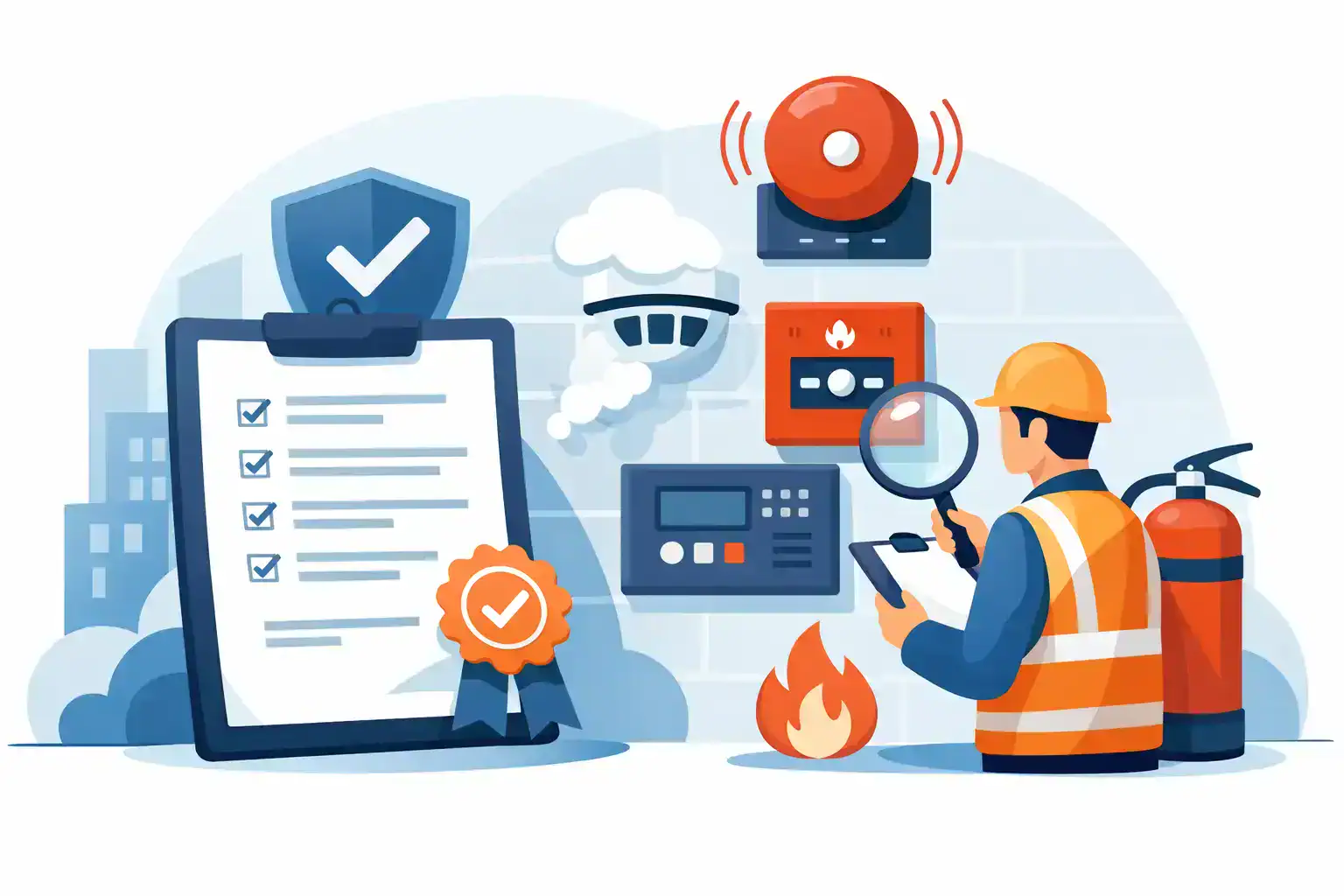
Fire Alarm System (Addressable / Conventional)

كل تصميماتنا مطابقة للكود السعودى والدولى

معتمدين من بلدى

معتمدين من امانة الرياض

معتمدين من هيئة مدن

معتمدين من الدفاع المدنى

Learn about the importance of contracting with an accredited engineering consultancy, the conditions and requirements involved, and how to choose the best engineering offices to manage and design your projects effectively and efficiently.
Contact us now or reach us on WhatsApp at the following number:
0557984942

© 2012 All Rights Reserved

Fire Alarm System (Addressable / Conventional)


Fire Alarm Systems: Addressable vs Conventional Fire alarm systems protect lives and property by detecting smoke, heat, or other hazards and alerting occupants to evacuate. Two common types are conventional and addressable systems. Each has its own strengths, costs, and best-use scenarios. What is a conventional fire alarm system? In a conventional (or traditional) system, field devices—such as detectors and manual call points—are grouped into zones. Each zone is connected to a corresponding circuit on the control panel. When a detector in a zone is triggered, the panel indicates which zone has activated, but it does not tell you exactly which device within that zone caused the alarm. Key characteristics: - Zone-based identification: You know the general area (zone) of the alarm, not the exact device. - Simpler, lower upfront cost: Typically easier to design for small to medium-sized buildings. - Wiring and maintenance: Uses separate cables for each zone, which can become bulky in larger spaces. - Typical devices: Smoke detectors, heat detectors, manual break-glass points, and audible/visual notification appliances connected to each zone. What is an addressable fire alarm system? In an addressable (or networked) system, every detector and device on the system has a unique address. The control panel communicates digitally with each device on a single or few communication lines, continuously monitoring status, fault conditions, and device health. The panel can pinpoint the exact device that triggered an alarm and often provides additional information such as sensitivity and recent activity. Key characteristics: - Device-level identification: The exact device location is known, often down to a specific room or fixture. - Diagnostics and maintenance: The panel reports faults, end-of-line conditions, and device health, making testing faster and more precise. - Efficient wiring: Addressable loops can reduce overall wiring compared to many conventional zones, especially in larger buildings. - Typical devices: Smart detectors, addressable manual call points, and addressable notification appliances that respond to the panel’s commands. Pros and cons at a glance - Conventional - Pros: Lower upfront cost, simple to design and install for small sites, easy to understand. - Cons: Zonal information only, more difficult to locate a device in large areas, more wiring for many zones, limited diagnostics. - Addressable - Pros: Precise location of alarms, detailed device status, easier maintenance, scalable for large or evolving buildings, better integration with building management systems. - Cons: Higher initial cost, more complex installation and commissioning, requires qualified technicians. Which system should you choose? - Building size and layout: Small shops or single-floor offices with straightforward layouts can be cost-effective with conventional systems. Large facilities, multi-story buildings, or spaces that require rapid, precise response often benefit from addressable systems. - Future expansion: If you anticipate adding more detectors or reconfiguring zones, addressable systems offer easier scalability and maintenance. - Maintenance and testing: If regular, quick testing and detailed fault reporting are priorities, addressable systems provide tangible advantages. - Budget and compliance: Local codes may influence the decision; some jurisdictions have stricter requirements for large or high-risk occupancies that align better with addressable systems. How to think about design and maintenance (high level) - Coverage and zoning: Decide how many zones (conventional) or how many devices (addressable) you need to cover the space effectively, balancing sensitivity and nuisance alarms. - Detection types: Choose appropriate detectors (smoke, heat, multi-criteria) based on occupancy, fuel load, and environmental conditions. - Notification strategy: Plan audible and visual alarms to ensure clear, timely evacuation without causing confusion. - Power and reliability: Ensure a robust power supply, battery backup, and regular testing per applicable standards. - Commissioning and testing: Regular commissioning, inspection, and maintenance are essential for both systems, with higher diagnostic capabilities generally reducing ongoing maintenance effort in addressable setups. A note on standards and safety Fire alarm design should follow local fire codes and standards, such as NFPA 72 in many regions, or national equivalents. Training for facility staff, proper installation by qualified technicians, and periodic testing are critical for reliable performance. Bottom line Conventional and addressable fire alarm systems each serve important roles. Conventional systems are often sufficient for smaller, simpler buildings and offer predictable costs. Addressable systems provide precision, advanced diagnostics, and scalability for larger or evolving facilities. When planning a fire alarm installation, weigh building size, risk, maintenance capability, and future needs to choose the right approach.


Fire Alarm System (Addressable / Conventional)

We are a consulting and contracting company in the same group, For pricing or design download our app, For any purchasing please contact us ASAP 


All designs are according to NFPA

© 2020 All Rights Reserved

Engineering & Safety Consulting Company Saudi Arabia
Saif – Engineering & Safety Consulting

Integrated Engineering & Safety Consulting Services

We are a specialized engineering consulting firm delivering comprehensive architectural, structural, mechanical, electrical, fire protection, industrial, oil & gas, and environmental engineering services. All designs, studies, and reports are prepared in full compliance with SBC, NFPA, FIDIC, API, ISO, and Saudi Civil Defense & MODON requirements.

🔧 1. General Engineering Consulting

  • FIDIC Contract Administration & Claims Management
  • Engineering Feasibility Studies & Technical Due Diligence
  • Project Management & Technical Supervision
  • Engineering Risk Analysis for Mega & Industrial Projects

🏗️ 2. Civil & Structural Engineering Consulting

  • Structural design of reinforced concrete & steel buildings
  • High-rise towers, bridges, tunnels, and road structures
  • Geotechnical & soil investigation studies
  • Seismic, wind & load analysis (ETABS / SAFE)
  • Structural assessment & retrofit of existing buildings

📐 3. Architectural Design & Urban Planning

  • Residential, commercial & mixed-use architectural design
  • Façade engineering & sustainable green architecture
  • Urban planning & master planning services
  • BIM modeling & coordination (Revit Architecture)

⚙️ 4. Mechanical Engineering Consulting

  • HVAC systems design & energy optimization
  • Water supply, drainage & plumbing systems
  • Pumping stations, compressors & industrial cooling
  • Fuel systems: Diesel, LPG & Natural Gas
  • Industrial mechanical & process systems

⚡ 5. Electrical Engineering Consulting

  • Low & Medium Voltage (LV/MV) power systems
  • Load calculations, voltage drop & short-circuit studies
  • Solar PV & renewable energy systems
  • Low current & ELV systems design
  • BMS, SCADA, CCTV & Access Control Systems

🔥 6. Fire Protection & Life Safety Engineering

This is our core specialty. All fire protection designs, reports, and approvals are delivered in strict compliance with SBC, NFPA, Saudi Civil Defense, and MODON regulations.

🔴 Firefighting Systems Design

  • Wet, Dry, Pre-Action & Deluge Sprinkler Systems
  • Foam systems, foam monitors & foam standpipes
  • Water Mist systems (NFPA / UL / FM)
  • Fire pump room & hydraulic calculations
  • ESFR, CMSA, CMDA & In-Rack Sprinklers

🔔 Fire Alarm & Detection Systems

  • Addressable, Conventional & Voice Evacuation
  • VESDA, Linear Heat & Video Smoke Detection
  • Smart & IoT-enabled fire detection systems

📄 Fire Safety Studies & Reports

  • Fire Strategy Reports
  • Fire Risk Assessments
  • CFD Smoke & Evacuation Analysis
  • SBC, NFPA & MODON compliance reports
  • Emergency & Evacuation Plans

🏭 7. Industrial Engineering Consulting

  • Factory layout & material flow optimization
  • Production line improvement & lean manufacturing
  • OEE, time & motion studies
  • Industrial piping & process engineering

🛢️ 8. Oil & Gas Engineering Consulting

  • API 650 & API 620 storage tank design
  • LPG, LNG & Natural Gas piping systems
  • Explosion risk & ATEX hazard studies

🌿 9. Environmental Engineering Consulting

  • Environmental Impact Assessments (EIA)
  • Air quality & emission monitoring
  • Waste & hazardous waste management
  • STP, WWTP & grey water systems

📞 Contact Us for Engineering Proposals

WhatsApp / Call: 0557984942

WhatsApp / Call: 0545587404

Email: project.manager@telal-elwatan.com
لقسم الاستشارات الهندسية والتقارير والشهادات ومتطلبات الدفاع المدنى والبلدية و هيئة مدن  يرجى الاتصال على 0557984942

للتوريدات والطلبات الاخرى يرجى ارسال طلبك واتس اب لخدمتكم

بشكل اسرع على احد الارقام التالية 0531433890 

X